Kannada Llama is a Tensoic model instruction-tuned for Kannada text generation, extending foundational large models into regional dialects.
To run Kannada Llama locally on your computer, the following requirements must be met:
No technical setup needed — anyone can try Kannada Llama using below mentioned steps.
Go to the Kannada Llama GGUF file on Hugging Face. Click the copy icon next to the repository name to copy the model path. (See image below.)
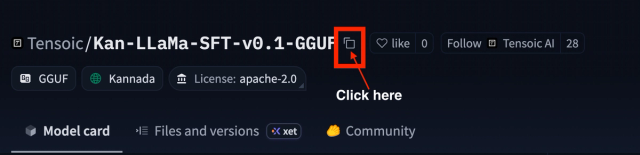
Open a terminal window and run the following command and paste the copied GGUF repository as mentioned below:
ollama run hf.co/PASTE_THE_COPIED_HERE
Press Enter.
Note: After pasting the repository, your command will look like this:
ollama run hf.co/Tensoic/Kan-LLaMA-7B-base
Ollama will download and initialise the model. Once ready, you'll see the following prompt:
>>> Send a message (/? for help)
Type your message at the prompt and press Enter to interact with the model.
To end the session, type:
/bye
Then press Enter.
Works in these languages, in both native script and Roman typing.
An honest look at what it does well and where it struggles.
Who builds and maintains Kannada Llama.

Tensoic is a small, community-style AI team known for Kan-LLaMA (Kannada Llama), a Llama-2 model continually pre-trained and fine-tuned on Kannada text and released openly on Hugging Face. It's a good example of low-budget, open fine-tuning making a real difference for an under-served language.